
Welcome to our special corner featuring articles that have undergone a significant update. In this fast-paced world of technology and business management, information quickly becomes obsolete. We believe in delivering not just current but also accurate and in-depth content.
Here, you will find updated articles that have been carefully revisited, revised, and enriched by our expert team to make them even more informative, accurate, and relevant for you. Browse through these gems, and you’ll find new insights added to what you may already know.
The articles are sorted from the most recently updated to the oldest. Dive in, refresh your knowledge, and keep up with the latest information without having to sift through new articles.
Updated Articles
Virtual Directory
Updated on: March 19, 2020
Virtual Directory is a directory that appears to Web browser users as a subdirectory of a Web site’s home directory but in fact might be located in a different folder, drive, or server.
Virtualization
Updated on: March 19, 2020
Virtualization refers to the act of creating a virtual version of any computer network resources like a server, switch, router, computer hardware platforms, storage device, etc.
vCard
Updated on: March 19, 2020
vCard is an Internet protocol for exchanging business information. vCard enables users to exchange the kind of information found on business cards by using standard Internet applications such as e-mail clients and Web browsers.
WOW
Updated on: January 10, 2020
WOW stands for “Win16 on Win32,” a component of the Microsoft Windows NT operating system that enables 16-bit Microsoft Windows applications (such as those designed to run on Windows 3.1 and Windows for Workgroups 3.11) to run properly on Windows NT’s 32-bit operating system. How WOW Works Like MS-DOS applications, 16-bit Windows applications (Win16 applications) […]
Windows Management Instrumentation (WMI)
Updated on: January 9, 2020
Windows Management Instrumentation, or WMI, is Microsoft’s implementation of the Web-Based Enterprise Management (WBEM) architecture for enterprise-level network management. Administrators can use Windows Management Instrumentation (WMI) to track, monitor, and control computers, networking devices, and applications belonging to an enterprise network over the Internet by using a standard Web browser such as Microsoft Internet Explorer. […]
Task Manager
Updated on: January 7, 2020
The Task Manager is a tool created by Microsoft for Windows NT and Windows 2000 that you can invoke by clicking the Task Manager button in the Windows Security dialog box. You access the dialog box by pressing Ctrl+Alt+Del, the secure attention sequence (SAS) keystroke combination. You can use Task Manager to: Start, view, change […]
Modem
Updated on: December 19, 2019
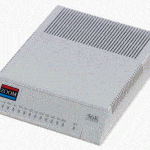
A modem is generally, any type of data communications equipment (DCE) that enables digital data transmission over the analog Public Switched Telephone Network (PSTN). The term “modem” (which actually stands for “modulator/demodulator”) is usually reserved for analog modems, which interface, through a serial transmission connection such as the RS-232 interface, with data terminal equipment (DTE) such as computers.
FTP service
Updated on: December 18, 2019
FTP service is a Microsoft Windows service on servers running Microsoft Internet Information Services (IIS). The FTP service supports the Internet standard File Transfer Protocol (FTP) and allows users to upload and download files between FTP clients and FTP servers such as IIS.
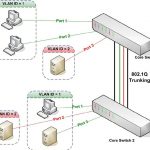
Trunking (computer networking)
Updated on: November 12, 2019
Trunking, in switched ethernet networking, is any method of aggregating the physical network links into a single logical link. Trunking provides a way of overcoming the bandwidth limitations of a single physical link and is used in both switch-to-switch and switch-to-server connections to relieve traffic congestion.